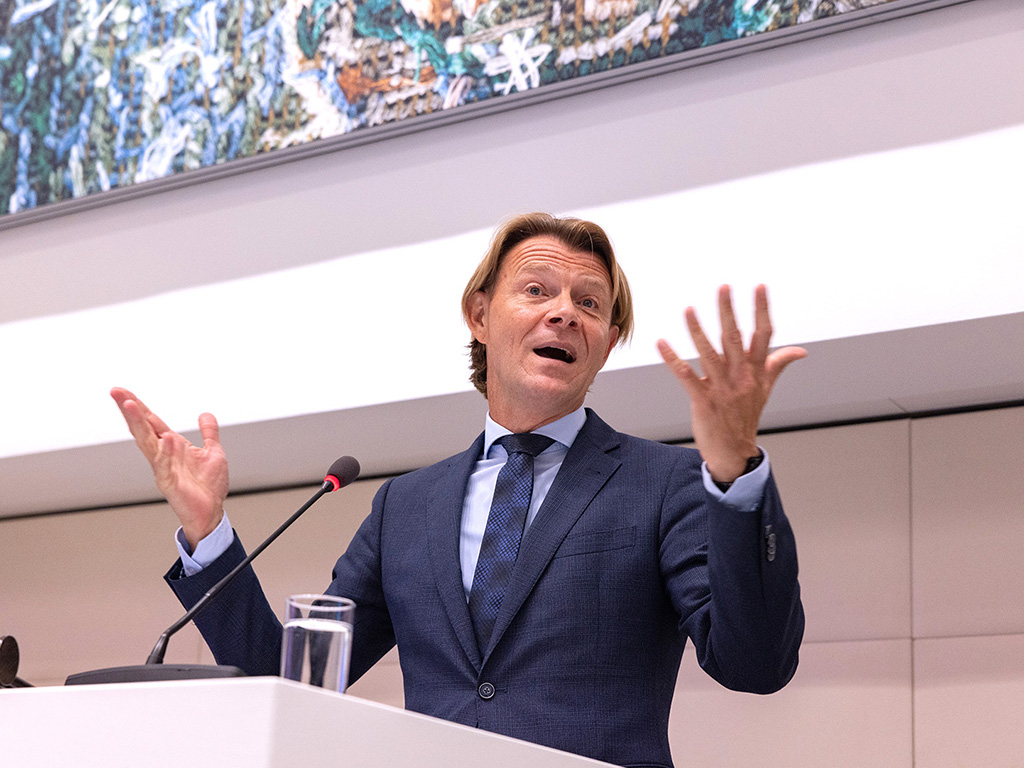
Competitiveness and Broad Prosperity, reflections on The Netherlands and Europe
Speech by Prof. Kim Putters at CEO Network Meeting hosted by the Ambassador of Denmark, 25 June 2026
Check against delivery
Opening
It is a real honour to speak to this group of Danish business leaders and Northern European ambassadors.
Denmark comes up time and again in my daily work — whether it is your innovative climate policy, the famous flexicurity model, or how to govern with a minority government.
In many ways, Denmark is a mirror for the Netherlands. Both of us are small, open economies — low on natural resources, high on prosperity — with broad prosperity at the heart of our politics. And both of us have an industrial champion that defines us abroad: ASML for the Netherlands, Novo Nordisk for Denmark.
We also share the same hard questions: productivity growth is slowing, the planetary boundaries to growth are near — in our case, the nitrogen crisis — and we face the uncomfortable question of which sectors to prioritise when labour, energy, space and public capacity are increasingly scarce.
I will cover three things today: first, productivity and the European industrial model; second, social dialogue as a democratic stabiliser; and third, the current stand-off between social partners and government in the Netherlands — and what it may teach others.
Productivity and the European model
Productivity and the state of European industry are rightly at the top of everyone’s minds: energy prices are high, and our industries face fierce global competition.
Let me offer one strength, one challenge, and one warning.
One strength
Europe should believe in the strength of its own model rather than try to copy others. The Netherlands and Denmark are the clearest proof that inclusive welfare provision and high productivity go hand in hand — they are not opposites 1.
We will not out-scale the data centres of the United States, nor the industrial overproduction of China. Our comparative advantage lies in the mobilisation of human capital — and a thriving welfare state is an absolute precondition for that. Denmark still stands out in Europe on this count.
One warning
In the current debate in the EU, we should be mindful that simplification is not used as a cover for ‘blind deregulation’.
To do so, a careful legislative procedure is of the utmost importance. Here, social partners have collectively expressed their worry about the Omnibus method we have seen recently, where Impact Assessments and balanced stakeholder consultation were omitted.
In our SER agenda for the European Union, we state that high-quality regulations are essential for broad prosperity and that any simplification attempt should be based on carefully constructed impact assessments.
And yet simplification itself is a legitimate goal — and a different thing entirely from deregulation.
We have real experience with this at the SER, through the Dutch Responsible Business Conduct (IMVO) agreements: business, trade unions, civil society and government around a single framework, built on OECD standards.
The lesson is that simplification need not mean lower standards. It can mean less duplication, shared reporting frameworks, and greater clarity for companies about what is expected of them.
In a competitive global economy, the objective should not be fewer responsibilities — it should be fewer unnecessary burdens and more predictable rules.
One challenge
I will be brief here — you will hear Peter Wennink next time – but his report talks about an investment gap of 151-187 billion to reach 1.5% growth.
My addition to his report is that the challenge is not to “invest at any cost”. It is to invest with direction: towards our earning capacity, our resilience, and our social stability — all three at once, not growth at the expense of broad prosperity.
If we do not invest in the sustainability of our businesses and the greening of our environment, we forfeit our goals to be autonomous and to provide a habitable society for all.
This also means securing a vital and healthy workforce which will tackle workplace absenteeism and allow our professionals to elevate their work performance.
Finally, - in addition to investment - the quality of work is key to ensuring productivity. Especially in the context of AI, we cannot sit idly by and allow the job market to lose its dignity and humanity for the sake of productivity.
If we want productivity to last, we must treat prosperity – not output – as our goal. The choice is not between productivity and people. Investing in one, is how we secure the other.
Social dialogue as a democratic stabilizer
It will not surprise you that I am a believer in social dialogue. But let me say why I think the role of social partners is becoming more important, not less.
Across Europe, politics is more volatile and elections more unstable. Research by Clancy and colleagues 2 finds that, many European countries change government roughly every two years, with long spells of caretaker government in between. In the Netherlands, we know this all too well.
Yet our challenges — productivity, climate, labour-market transitions — demand long horizons and sustained political attention.
This is where civil society earns its keep: as a democratic stabiliser, holding governments to long-term agreements, and guarding us against zig-zag politics and short-sightedness.
At the SER, our strength is precisely that we work beyond the issues of the day — we can set out the long lines. In a time of large ideological and political shifts, that is enormously valuable.
Take the Dutch pension agreement of 2019. It took almost a decade to reach. But because it was built through patient social dialogue, it carries a legitimacy and authority that, even now, shields it from political attempts to unpick it.
We need more agreements like this for our long-term challenges. In that spirit, I applaud Denmark’s 2024 Green Tripartite agreement on nitrogen and agriculture — it served as an example for our own forthcoming advice on the future of Dutch farming.
The current stand-off between social partners and government
Let me close with the present moment. I am hopeful about broad agreements — but right now, Dutch social partners and the government are in a serious stand-off. It has been remarkably hard simply to get people back around the table.
Two lessons from recent months that, I think, hold value beyond our borders.
First — the narrative
The Netherlands has embarked on an experiment with a minority government. That is risky, but it can work — Denmark shows as much.
The real culprit is not the form but the framing: a narrative of “welfare versus warfare.” Telling citizens that we must cut social provision to pay for defence is risky business — and it puts the trade unions immediately on the defensive.
Budgetary choices have to be made. But the question should be which welfare policies best support a thriving economy — one strong enough to sustain high costs, including defence spending. Changing that tone is the precondition for getting everyone back to the table.
Second — the way out
This brings me to my second reflection: I believe the way out lies in a broad prosperity agreement — not in a narrow fight over single instruments under heavy budgetary strain.
We need to combine the concrete steps of Wennink’s growth agenda, with support for businesses facing high energy costs, and a strong social agenda for the labour market of the future. For the latter, the Danish flexicurity model serves as an important inspiration.
Within that broader dialogue — grounded in a shared vision of the future economy — we can also, honestly, raise the long-term affordability of our welfare institutions. But only ever alongside the recognition that effective welfare policy is not merely a safeguard for social standards; it is an essential part of our socio-economic model.
Close
So let me end where I began. The real question is not only how the Netherlands or Denmark stays competitive — but what kind of competitiveness we want to build.
A competitiveness built only on cost, scale and growth is fragile. A competitiveness embedded in broad prosperity, strong institutions, and patient long-term investment is durable.
The Treaty of the European Union defines the EU as a social market economy (art. 3) with the highest levels of protection for people and the environment (art. 7&12 TFEU). So strong regulatory standards on sustainability are in our constitutional DNA and we should protect our European model at any cost. I am confident that a Europe that stays true to its own model is also one that will bring in investment and economic prosperity.
That is the shared task for the Netherlands, for Denmark, and for Europe. And it is a task we are far more likely to master together than alone.
Thank you.
- Erken et al. (2026), Concurrentiekracht en Brede Welvaart; Een vergelijking van Nederland met België, Denemarken en de VS.
- Clancy et al (2023), Many countries in Europe get a new government at least every two years. PeW Research Centre.